


Understanding Cat Escape Artists: Why Oscillot Works for Different Personalities

Understanding Cat Escape Artists: Why Oscillot Works for Different Personalities
Every Cat Has a Unique Escape Strategy—Oscillot Stops Them All
Not all escape attempts are created equal. Some cats are determined climbers, obsessively testing every inch of fence for grip points. Others are explosive jumpers, capable of clearing obstacles with explosive power and athleticism. Many possess the cunning to learn from other cats' escape attempts, developing increasingly sophisticated tactics. Understanding your cat's escape personality is crucial to selecting the right containment solution—and why Oscillot's mechanical spinning-paddle technology succeeds where traditional fences fail, regardless of your cat's specific escape strategy.
This comprehensive exploration examines five distinct escape personalities, explains the specific techniques each uses to attempt escape, and demonstrates how Oscillot's design prevents every single escape strategy through pure physics and passive mechanical design.
The Climber: Vertical Territory Specialists
Escape Personality Profile:
Climbing cats are naturally vertical felines who spend significant time in trees and elevated spaces. These cats are anatomically optimized for climbing—muscular hind legs, sharp claws, and heightened vertical spatial awareness.
Climbing Escape Strategy
Climbers exploit every fence imperfection:
- Wood grain and texture: Rough timber fence surface provides countless grip points
- Horizontal fence lines: Cats use these as launching platforms to reach higher points
- Chain-link interstices: Individual wire squares provide perfect climbing holds
- Vinyl seams and overlaps: Slight height variations create climbing routes
- Corner and junction stress concentrations: Material irregularities become climbing paths
A determined climbing cat approaches a traditional fence with systematic technique: launch with powerful hind legs, dig claws into fence material, use front paws to test for higher grip points, and methodically pull upward. Even subtle surface irregularities provide sufficient grip for feline claws to gain purchase.
Why Traditional Fences Fail Climbers
Even fence toppers eventually become obstacles for determined climbers to navigate around or over. Angled extensions and rolled barriers slow climbers temporarily but provide new surfaces to test and exploit. The climbing cat's fundamental advantage is that traditional fences offer unlimited surface texture for grip—they're essentially designed as climbing structures.
How Oscillot Defeats Climbers
Oscillot's spinning-paddle design eliminates climbing opportunities entirely through physics:
- Zero grip surface: Paddles provide absolutely no grip surface—no texture, no edge, no leveraging point
- Rotating response: As a cat's paws contact the paddle, the paddle rotates freely, negating any pushing force
- Momentum absorption: The spinning paddle converts climbing force into rotational motion, preventing upward progression
- Passive operation: The system requires zero electricity or external intervention—the cat's own escape attempt triggers the mechanism that prevents escape
- Learned futility: After repeated unsuccessful climbing attempts, even determined climbers recognize that climbing is impossible and redirect their energy toward acceptable outdoor enrichment
The Jumper: Height and Distance Masters
Escape Personality Profile:
Athletic cats like Bengals, Abyssinians, Savannahs, and high-energy domestic breeds can clear standard 1.8-meter fences through a combination of running start, powerful leg drive, and sustained vertical leap reaching heights exceeding 2 meters.
Jumping Escape Strategy
Jumpers exploit height limitations through athleticism:
- Running start approach: Build momentum with 3-5 meter running start before fence encounter
- Hind leg power: Explosive extension of powerful hind legs provides upward thrust
- Fence contact technique: Front paws contact fence to define jump trajectory; powerful leg drive continues upward motion
- Fence-top clearance: Flexible spine and light body mass allow clearing even fences higher than ground-to-withers height
- Landing execution: Flexible landing mechanics allow safe escape even from high fences
Why Traditional Height Alone Fails Jumpers
Many property owners believe simply building a taller fence solves the jumping problem. This overlooks the fundamental reality: athletic cats can jump higher than economically practical fences. Standard residential fencing at 1.8-2m is insufficient for the most athletic breeds. Professional facilities containing escape-artist cats often use fences exceeding 2.4m—impractical and aesthetically unacceptable for residential properties.
How Oscillot Defeats Jumpers
While Oscillot's system works best on existing fences of adequate height, the psychological effect of the spinning paddles defeats jumping attempts through a different mechanism:
- Instinctive surface avoidance: Cats instinctively avoid surfaces they cannot grip
- Approach hesitation: When a jumping cat approaches the fence line and encounters the unstable, rotating paddle assembly, they instinctively hesitate
- Jump abandonment: Cats reflexively abandon jump attempts when they cannot secure landing surface
- Instinct override: The natural climbing/jumping instincts are bypassed by the paddle's fundamental design—it simply cannot be exploited for jumping
- Behavioral modification: Without successful jumps, cats gradually stop attempting jump escapes and accept containment
The Escape Artist: The Clever Learner
Escape Personality Profile:
Some cats are exceptional problem-solvers and planners. These cats demonstrate remarkable capacity for environmental learning, pattern recognition, and tactical problem-solving—applying these abilities specifically to escape planning.
Clever Cat Escape Strategy
Problem-solver cats approach escape as a puzzle to be solved:
- Systematic environmental study: Study fence systematically, testing different sections
- Weakness identification: Identify sections most likely to provide escape opportunity
- Pattern learning: Recognize patterns in fence structure that might offer advantages
- Technique development: Develop and refine specific escape tactics
- Persistence: Return repeatedly to promising escape routes, gradually perfecting technique
Why Traditional Solutions Fail Clever Cats
Cage enclosures and netting systems are particularly vulnerable to clever cats because they're designed as temporary solutions with numerous potential weak points. A clever cat methodically tests every connection, every seam, every fastener until a vulnerability is found. Once found, the exploit is refined and eventually successful.
How Oscillot Defeats Clever Cats
Oscillot defeats clever cats through an elegant principle: there is no pattern to exploit, no surface to grip, and no technique that works:
- Pattern elimination: Every paddle is identical; no variation provides escape opportunity
- Feedback loop creation: A cat cannot learn to climb rotating paddles because paddles respond to escape attempts by rotating
- Ineffective tactic reinforcement: Each failed escape attempt reinforces the futility of escape tactics
- Learned impossibility: After repeated unsuccessful attempts (typically 5-10 over several weeks), even the most determined escape artist recognizes that escape is impossible
- Energy redirection: Freed from escape obsession, clever cats redirect their problem-solving intelligence toward acceptable outdoor enrichment activities
The Social Learner: Multi-Cat Escape Dynamics
Escape Personality Profile:
Perhaps the most challenging scenario is a multi-cat household where one cat is a determined escape artist and others are observant learners. Experienced escape artists demonstrate their techniques to other cats, creating an "escape contagion" effect where success by one cat teaches others to attempt similar strategies.
Multi-Cat Escape Dynamics
Social learning in multi-cat households creates unique challenges:
- Observation and learning: Other cats watch escape artist attempt techniques and observe success/failure
- Technique replication: Observing cats imitate successful escape strategies
- Tactical refinement: Multiple cats testing same escape route refine technique through repeated attempts
- Motivation amplification: Success by one cat motivates others to escape; failure by others motivates escape artist to persist
- Behavioral escalation: Escape obsession spreads through household, consuming behavioral resources
How Oscillot Prevents Escape Contagion
Oscillot prevents social escape learning because no tactic works against rotating paddles—there's literally nothing for other cats to learn:
- No replicable technique: Observing cats see only failed escape attempts; no successful technique to imitate
- Unanimous futility: Every cat encounters identical rotating paddle response; no variation provides learning opportunity
- Motivation cessation: Without any escape success, motivation to attempt escape gradually diminishes
- Energy reallocation: Freed from escape obsession, even socially-motivated escape artists redirect behavioral energy toward acceptable activities
The Anxious Cat: Safety Through Predictability
Escape Personality Profile:
Conversely, some cats aren't escape artists—they're anxious about open spaces and respond well to secure outdoor containment. For these cats, the primary benefit of containment is psychological security rather than escape prevention.
Anxiety-Based Containment Needs
Anxious cats benefit from containment through psychological mechanisms:
- Predator anxiety: Secure boundary eliminates anxiety about predators (birds of prey, larger animals)
- Traffic safety: Clear boundary eliminates traffic danger and anxiety
- Territorial anxiety: Defined containment eliminates anxiety about unfamiliar territorial incursions
- Navigation safety: Knowing boundaries removes anxiety about getting lost or disoriented
Why Oscillot Benefits Anxious Cats
Oscillot provides ideal psychological support for anxious cats:
- Predictable mechanical response: Paddles respond consistently to contact—no surprises or sudden movements
- Passive operation: No electricity, no unpredictable electronic behavior, no sudden alarms
- Gentle learning: Paddlecontact is gentle and non-threatening—cats learn boundaries through safe exploration, not fear or pain
- Calm reinforcement: Repeated gentle contact with paddles creates calm understanding of boundaries, not traumatic learning
Personality-Based Containment Strategy: Matching Solution to Cat
Installation Configuration by Escape Personality:
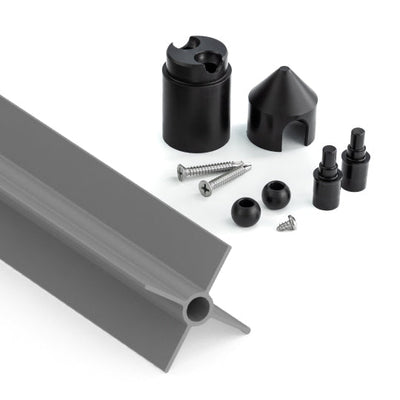
- Climbers: Standard installation on 1.8m+ fences with complete perimeter coverage (choose appropriate kit size: 1.2m–92.9m available)
- Jumpers: Installation on maximum available fence height; no climbing aids; may benefit from angled extensions on top for additional psychological deterrent
- Clever Cats: Multi-layer installation with Cat Tree Guards protecting climbing routes; continuous comprehensive coverage with no gaps
- Social Learners: Separate territorial zones within same installation; prevents observation of other cats' escape attempts
- Anxious Cats: Full perimeter coverage creating complete psychological security boundaries
Kit Selection by Personality:
- 1.2m–2.5m kits (€40–€64 on sale): Suitable for climbers and anxious cats in small spaces
- 3.7m–6.2m kits (€88–€152 on sale): Ideal for average residential properties with 1-3 cats
- 12.4m–31m kits (€288–€680 on sale): Multi-cat households with separate territorial zones needed
Why Other Solutions Fail Different Escape Personalities
Electric Fence Systems
- Cause stress and pain, traumatizing anxious cats completely
- Clever cats learn that collar removal or battery depletion allows escape
- Increasing EU welfare regulations restrict shock-collar systems
- Potential liability for injury claims (cats injure themselves fleeing electrical shock)
- Psychological stress creates long-term behavioral complications in all personality types
Netting Systems
- Vulnerable to determined climbers who find weak points in netting
- Pose entanglement risks for all cats, especially climbers
- Clever cats methodically test every connection until finding escape route
- Require frequent replacement as netting degrades from sun exposure
Cage Enclosures
- Restrict natural cat behaviors and territorial expression
- Cannot accommodate multiple cats' territorial needs for different personalities
- Create behavioral stress in all personality types, even when escape-proof
- Clever cats exploit structural weak points in custom-built enclosures
Professional Installation for Complex Personalities
For particularly challenging escape artists or multi-cat households with conflicting containment needs, Oscillot offers professional installation partnerships. Airtasker-partnered installers understand the nuances of cat behavior and can design solutions tailored to your specific household personality profiles, ensuring optimal containment and enrichment for all cats regardless of their escape tendencies.
The Bottom Line: Understanding Enables Optimization
Your cat's escape personality doesn't determine whether Oscillot will work—it only determines which installation configuration optimizes their outdoor enrichment experience while maintaining the escape-proof security that makes outdoor access possible.
Shop Cat-Proof Fence Kits for All Personality Types
Oscillot adapts to every cat personality because the technology itself is inherently escape-proof. There is no learning curve, no behavioral conditioning required, and no risk of failure due to individual cat variations. Every cat, regardless of escape personality, encounters the same rotating paddle technology that prevents their specific escape strategy.